Henry Bermudez at the Crossroads of Artistic Traditions
Patrice Giasson
Alex Gordon Curator of Art of the Americas, Neuberger Museum of Art
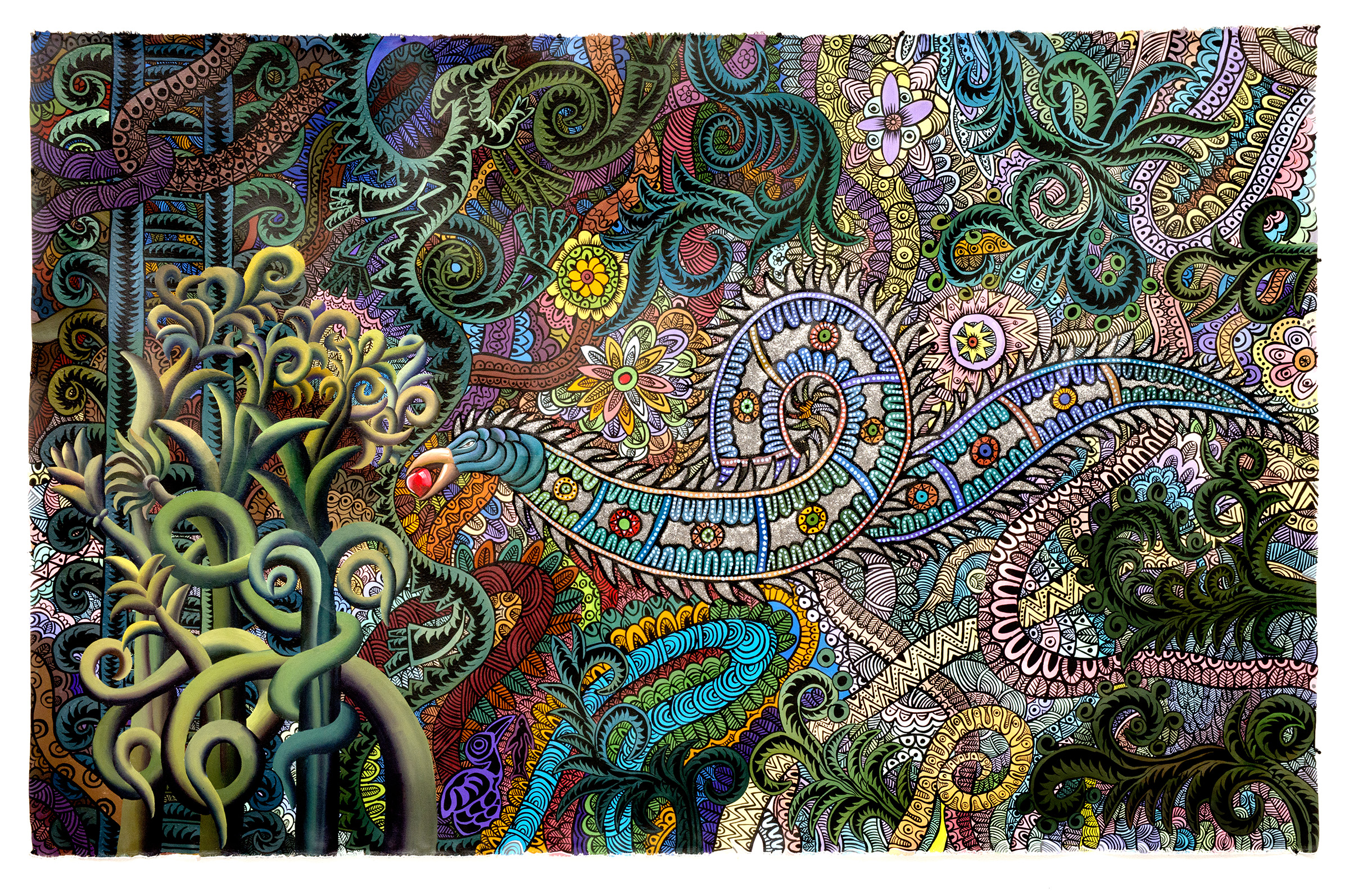
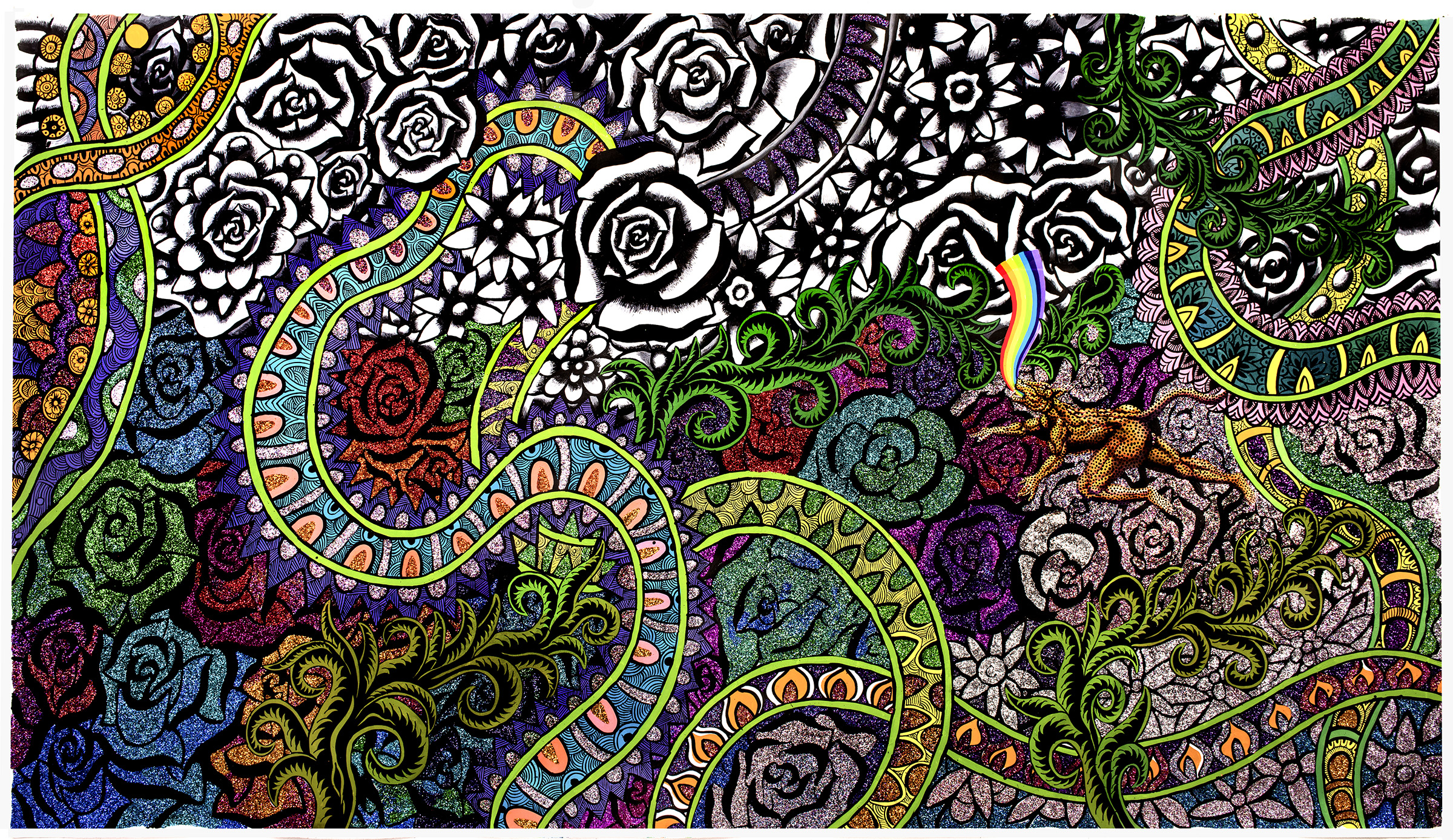
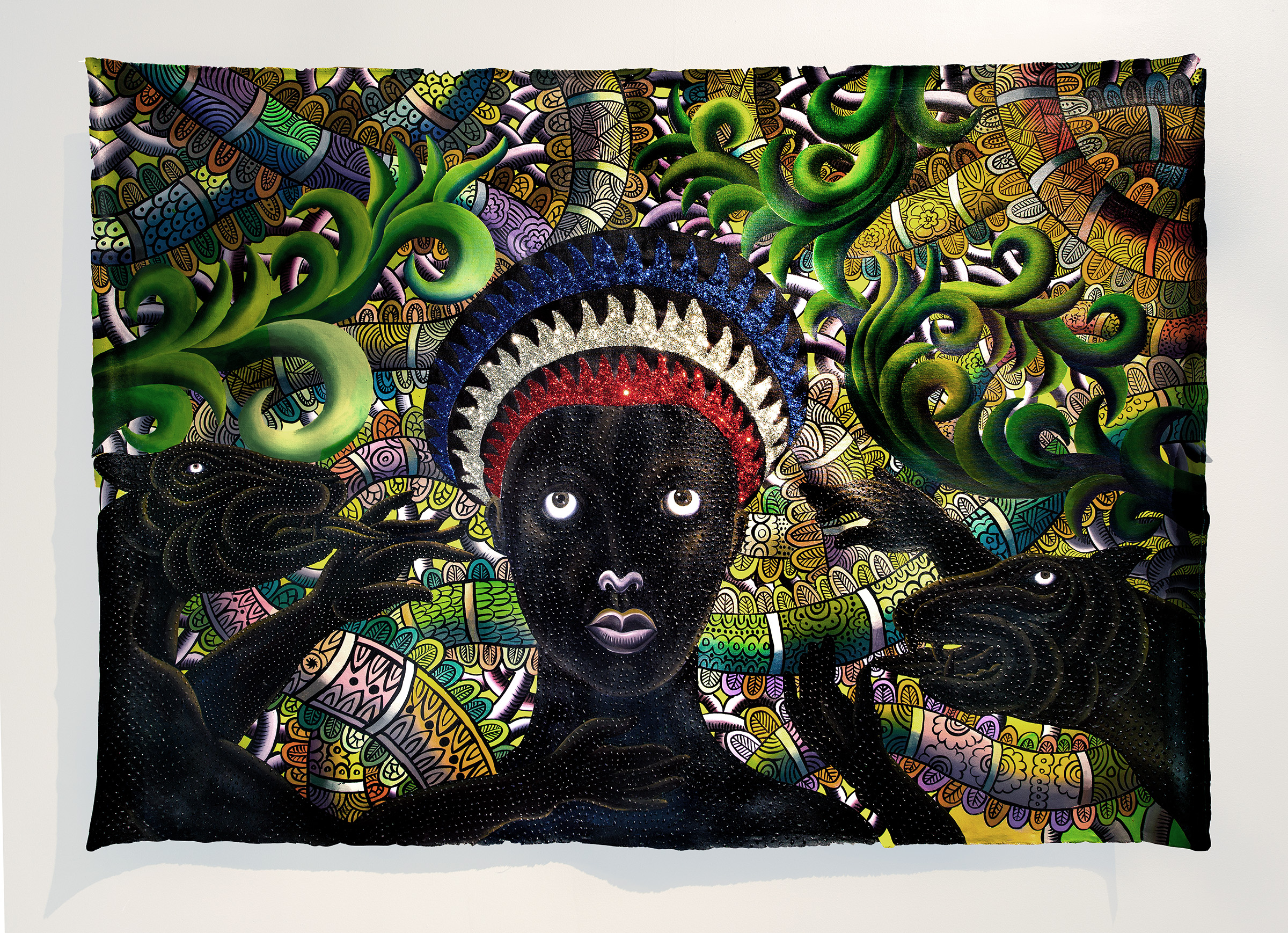
When I first wrote about Henry Bermudez, whose painting Pájaro con pinta de tigre (Bird with a Tiger’s Appearance) (1991) is one of the gems of the Latin American collection in Neuberger Museum of Art, I mentioned that his work was “at the crossroads of European painting, pre-Columbian imagery, and Santería.”1 Now that I have had the chance to explore the vast body of works that he has created in over thirty years of active career, I am even more convinced of the importance of understanding his art through the prism of a complex and articulated crossroads, to which I would now add several other components, beginning with the presence of Concrete Art elements. Derived from Geometric Abstraction, Concrete Art was based on a rejection of figuration and interest in pure geometry, lines and colors, and optical illusions, and has dominated much of the South American production since the mid-20th century. Another component of the crossroads of Bermudez’s work is the baroque art and architecture, visible across colonial churches in Latin America and characterized by an unappeased thirst for details with saturated ornamentation. Bermudez’s work is also tied to mural painting, exploring its site-specificity and social engagement, which the Mexican muralists brought forward so vigorously during the decades following the Mexican Revolution of 1910-1920. Finally, at this intersection, I would add the implicit dialogue that the work engages with contemporary figures, including American artist Kara Walker and her exploration with large figurative paper-cut installations.
In order to better explore and explain the nature of this dialectical crossroads, I identified different key sections through which I will analyze specific works.
European and American Jungles
Bermudez’s Pájaro con Pinta de Tigre2 evokes a sense of sacredness and magic and seems dominated by the theme of the jungle. But while speaking with Bermudez I discovered, interestingly, that the theme of the jungle did not derive from the Cuban artist Wifredo Lam, whose work Jungle (1953) hangs on the walls of the Museum of Modern Art, but from the Post-Impressionist Henry Rousseau, who Bermudez admired after assigned as a young art student to analyze the French painter’s work. However, while Rousseau never visited the jungle, Bermudez traveled to the Amazon. Bermudez also visited Mexico, and the animal featured in Pájaro con pinta de tigre bring to mind the hybrid creatures present in the Mesomaerican world. The theme of the jungle is emblematic of Bermudez’s works throughout his ongoing career and Pájaro con Pinta de Tigre is part of a larger body of work with similar themes.
Relevant from that era is the work Amazonia, an oil on canvas created in 1992, a year after Pájaro con Pinta de Tigre, when Europe was celebrating Cristobal Colón’s “discovery” of the Americas: meanwhile, many Latin-Americans were engaging in counter-celebrations recalling the darker sides of the discovery. Amazonia, like the work in the Neuberger’s collection, consists of a dense and colorful jungle landscape, from which emerges the portrait of a woman in profile based on the iconic Renaissance diptych by Piero della Francesca entitled The Duke and Duchess of Urbino (1467-1472). Bermudez excluded the Duke from his image to only feature the Duchesse Battista Sforza, who reappears in several of his works from that era. In his Amazonia, the Duchesse is paired with her enigmatic reflection mirrored in the waters of what is most likely the Amazon River. She is surrounded with imaginary creatures and other zoomorphic forms emerging from the dense vegetation. Stoic like a Pre-Columbian sculpture, the Duchesse does not seem bothered by the presence of the humanized tiger behind her shoulder that looks ready to strike, or by the numerous bird heads that emerge from within the entangled river. Nor does she seem bothered by the powerful confrontation between the two identical feathered snakes in front of her: large snakes that without a doubt refer to Quetzalcoatl, the God of the Arts to which the Aztecs had dedicated a temple in the heart of Tenochtitlan. Two universes are thus confronted; the Renaissance and the Mesoamerican. Created between 1465 and 1472 before the discovery of the Americas by the Europeans, the presence of the Duchesse Battista Sforza in the Amazon is a historical subversion. Bermudez plays with the history of Latin America and the history of art. He appropriates the Western canon and ultimately creates an anachronic image, while subverting the content. The original landscape behind Battista Sforza in Piero della Francesca’s painting depicted the vast and open territory onto which, because of their aerial vantage point, the Duke of Urbino appeared to have total control over. However, in Bermudez paintings featuring Battista Sforza, the Duchesse seems always absorbed into the landscape, as if swallowed. One cannot help but think of Brazilian Osvaldo de Andrade’s Anthropophagic Manifesto (1928), which celebrates the ability of the Brazilian people to metaphorically swallow foreign Western influences in order to make them operate under their own Brazilian paradigm. For many, Andrade’s manifesto came to characterize the struggle of artistic and intellectual independency that was emerging throughout all of Latin-America along the 20th century.
Bermudez’s mastery also lies in his capacity to create harmony between distinct artistic and cultural references, and to blend them into a singular image. The various elements present in his Amazonia seem to move and breathe with a similar rhythm, like in a Van Gogh painting, as if they were part of one single vision emerging from the artist’s subconscious. Like with Pájaro con Pinta de Tigre, his work Amazonia recalls Henry Rousseau’s work, where the dreamlike and the subconscious dominate. Along these lines, Bermudez is also in tune with the Surrealists. The snake in Western culture has always been associated with the phallic symbol, which would invite a psychoanalytical reading of his work in which the dreamlike infiltrates reality. What is the Amazon river for the Western travelers if not an imaginary over-sensualized paradise? The jungle in this work appears as a sort of Eden, but located, this time, in the heart of the New World.
The blurring of references between day and night in this work also appears as a metaphor of the dual component of the mind: conscious/unconscious, reality/dream. The nature featured in Amazonia is so dense that one can hardly know if it’s day or night. While the bottom of the scene is dark, rays of light emerge from the top of the vegetation. The work could thus be read as a dual representation of day and night —like in the Mesoamerican pantheon and sacred beliefs where everything is counterbalanced by an opposite force— or understood as the result of a timely depiction of a whole day, which would supplement the general sense of motion; mobility in both space and time.
Squares and Lines: A Dialogue with Geometric Art
Between 2012 and 2015, Bermudez openly ventured into geometric abstract art, in a series of exquisite drawings with pen and ink on paper. He engaged with the traditional squares, triangles, and lines recurrent in South American Concrete art. His works Four Color Lines (2012); Square (2014), Two Square II (2014); and Gray Square at Front (2014), depict geometric forms contrasted with a powerful background of vegetation. In all of these works, the purity of line is defied by the accidental of the baroque. Bermudez opposes the rigidity of geometry to the unexpected, and malleable, organic world. While demonstrating Bermudez’s mastery of Concrete art, these works explicitly show his capacity to juggle multiple styles. Nevertheless, Bermudez seems to remind us that, whatever he is confronted with, his imagination is always rooted in the deep territories of South America. I remember observing a similar phenomenon with some Québécois artists and writers, like painter Jean-Paul Lemieux (1904-1990), whose paintings reflected the presence of winter, or poet Émile Nelligan (1879-1941), whose verse Oh! How the snow's been snowing! (in Winter Night) was rooted in the heart of winter. The winter became a leitmotif for creation. Like these artists from Quebec for whom the snow was not a blind patriotic celebration of their homeland but a horizon from which they could see the world, Bermudez uses the idea of the jungle, the magical, and the allegoric as a point of departure to create his own personal universe.
Muralismo: The Inside-Outside
Henry Bermudez’s artistic production includes numerous mural projects. By nature, mural paintings are always site-specific and his murals all over Philadelphia blend in with the environment. In his mural at 4th and Brown Streets and at the Mandler Recreation Center, the surrounding vegetation seems to enter or escape from the painting. The borders between nature and the representation of nature are thus blurred, and so is the separation between reality and fiction. The real world is juxtaposed, and to some extent confused, with the fictitious world that the artist creates. This seems to derive in part from the ideas of magical realism associated with South American literature. Knowing that one of the main figures of Magical Realism is Gabriel Garcia Marquez, who was originally from Colombia — very close to Venezuela where Bermudez lived until 2003— one can deduct the possible influence. On the other hand, one can also read in this correlation between the work and its surroundings, a dialogue between the outside, public and open world, with the intimate and subconscious imaginary of the artist, which comes to us as a universe made of dreams, intertwined symbols, and zoomorphic vegetation.
The modern mural tradition in the Americas was, as many are aware, launched by the great Mexican painters of the beginning of the 20th Century. The subject matter of several of these murals (in particular the work of Diego Rivera) was frequently a highlighted aspect of the Mexican history, for example remembering national heroes or reigniting the history of the Native Americans. The mural tradition quickly expanded into the United States and has since then been revitalized several times, in particular through the works of Chicano artists who converted it into a tool for social recognition and the creation of a collective imaginary built around the idea of the Mestizo. This itinerary of mural art, and its political and social revival in Latin American communities within the United States might explain Bermudez’s interest in including the image of Natives and Afro-American populations. By way of illustration, three young Afro-American kids are featured in a mural at Mandler Recreation Center as a way to engage with local communities. On the other hand, these questions may also derive from an interest in exploring his own personal history, as someone who grew up in an Afro-Venezuelan family—as we can observe in his mural African Caribbean Landscape (at Erie and 11th Street) featuring both an African man and a Native woman. Around these figures predominates the un-erasable jungle-vegetation, a trademark of Bermudez’s imaginary.
But Bermudez, to reiterate, is very aware of other artistic practices particular to South America, such as Concrete Art and its subsequent versions which still predominates in the contemporary artistic creation. His mural Circle (2016) —at Circle Thrift, Dauphin & Frankford Ave— features his emblematic embroidery baroque motif in the center of a concrete art geometric landscape that recalls works by Sol LeWitt. The background, and the green colors that Bermudez included in some of his stripes seem to expand naturally with the green neo-art-deco architecture of building’s façade adjacent to the mural. The yellow dot at the heart of the embroidered center — which echoes a sun in its zenith— facilitates the harmony between the center, which is figurative, and the geometric assemblage that surrounds it. In that sense, Bermudez defies the “laws” attached to the origins of Concrete Art, based on a rebuking of any forms of representation. The tentacles of his vegetation play with the firmness of line and geometric shape.
The Art of Paper Cut
In terms of technique, Bermudez is without a doubt a master painter, but he also uses the paper-cut technique. These works range from large paper-cut projects undertaken since 2009 to precise small paper-cut drawings created in 2012. One of the most impressive paper cut works is his project for the Philadelphia Airport, entitled Baroque Landscape (2011), which measures 108 by 444 inches.
The technique of the paper cut is widespread in Mexican popular culture: one just has to think of the famous paper-cuts in Mexican fairs and celebrations. However, the work at the Philadelphia Airport has an Asian feeling of sorts, and brings to mind the large paper dragons that are seen in Chinese popular art. This “oriental” sensation appears in the way the vegetation curves, and also through the presence of tigers. It is worth observing, though, that tigers (or jaguars) are present in both Mexican and Chinese traditional arts. In ancient Mexican culture, the tiger is associated with the infamous jaguar-warriors, which can be observed in pre-Hispanic murals.
The center of Baroque Landscape features an entangled mass of vegetation that takes the form of an undecipherable Arabic calligraphic text. But, as the title itself seems to indicate, all these curves recall without a doubt the abundance of detail found in the retablos and baroque architecture predominant in colonial Latin American churches. The botanical aspect of Bermudez’s jungles also brings to mind the floral motifs found in neo-baroque design.
By using the art of cut paper, Bermudez is also able to expand the traditional two-dimension painting into a sculptural installation that spills from the frame into the gallery space. This is the case with The Four Sad Tigers (2016), a large 42 by 72 inches acrylic paint on cut paper. This black monochrome work features tigers plunged into a floral landscape, similar to Baroque Landscape. One can only imagine the amount of work that went into its creation, with hundreds of little cuts into the work which. In lieu of employing the old European technique of Pointillism, Bermudez instead creates small openings into the black forms through which the white wall of the gallery transpires. This work seems in tune with the work of another major contemporary artist, Kara Walker, and the shared interest they have for figurative silhouette-like paper-cut representations, and social-historical themes.
Subverting History
Some of Bermudez’s work humorously takes on central themes of the history of the Americas, as is the case with an earlier paper-cuts he created about the voyages of Prussian Alexander von Humboldt in Venezuela between 1779 and 1780.
One of the works, entitled What Mr. von Humboldt Saw When He Visited the Orinoco (2008), alludes to Humboldt’s scientific voyage along the Orinoco river, the longest river of South America which crosses through Venezuela —Humboldt explored a wild territory, virtually uninhabited, that was almost unknown to Europeans. Bermudez’s painting offers a metaphorical depiction of the world that Humboldt encountered when entering into the deep jungle surrounding the river; an unknown territory that could bring forward all sorts of impossible images. Everything is camouflaged, the chameleon-like mythical beasts are taken over by the jungle, which only allows a partial view; not the whole figure, barely a silhouette melted up into the vegetation. Furthermore, every living thing, either fauna or flora, is covered with dark spots, a Pointillism of sorts, that adds to the camouflage and the blurring between plants and animals.
From Maracaibo to Philadelphia
Bermudez, as we have seen, is familiar with the masters of the Renaissance and the later European avant-gardes. More than disdaining or challenging European artistic traditions, or mainstream American art, Bermudez assumes the legacies. Bermudez is also well aware of the geometric abstract movements that influenced numerous Venezuelan and other South American artists that developed into Concrete Art and Optical Art. He also had a chance to study in Mexico, where Mesoamerican art, highly promoted since the 19th century, is visible everywhere, and where public markets still flourish with Native craft. Bermudez create singular images that ultimately result in a communion between several artistic traditions; his work is neither European or American, neither exclusively Western, Afro-Caribbean, or American; it is all of these at the same time.
Bermudez was in contact with local Venezuelan culture when he grew up in Maracaibo, a coastal city with Afro-Venezuelan roots. This region was the heart of a powerful devotion to a Black Saint called San Benito, as well as different forms of Santeria practices. Bermudez once explained that as a young boy he accompanied his great-aunt—who believed a spell had been cast upon her—to sessions with mediums and shamans where he witnessed mystical ceremonies that had an impact on his life and future artwork. This may explain the nature of some of his works, its entangled messages that call for interpretation, its secret worlds that need to be deciphered by each viewer. Many bridges could be built between his art and the work of other artists like late Wifredo Lam, a strong advocate of Afro-Caribbean art, who wanted to make African art operate in the Americas. However, Bermudez, who has now lived for several decades in Philadelphia, is a concealer, and sees no contradiction between all of the artistic traditions operating in his work. The jungles are always at the center of his work, but they are open enough to allow a fluid passage between different art currents, becoming this creative crossroads that allows him to situate himself in the 21st century.
Notes
1. Giasson, Patrice, ed., Destination: Latin America. Modern and Contemporary Latin American Art from the Collection of the Neuberger Museum of Art. New York: Neuberger Museum of Art, Purchase College, State University of New York, 2018, p. 56.
2. Ibidem.